Family Violence at Christmas and New Year: Why Awareness Matters
Research highlights increased family violence risk during the holidays and opportunities for targeted, discreet support messaging.
Read more

Public health campaigns have played an important role in promoting participation in screening programs and improving awareness of symptoms. However, screening participation rates remain well below optimal levels. This raises an important question for policymakers and campaign planners:
How can public health communication better convert awareness into action?
According to the Australian Institute of Health and Welfare (AIHW), bowel cancer is the second leading cause of cancer death in Australia, responsible for more than 5,300 deaths annually, with approximately 15,500 Australians diagnosed each year.
Encouragingly, bowel cancer is also one of the most preventable cancers when detected early through screening. Australia’s National Bowel Cancer Screening Program (NBCSP) provides free home screening kits to Australians aged 50-74 and has been shown to significantly reduce mortality through early detection [1].
However, participation remains below the levels required to maximise the program’s public health impact.
Participation in the National Bowel Cancer Screening Program currently sits at 41.7% nationally, meaning that more than half of eligible Australians do not complete the screening test when invited.
Participation in bowel cancer screening is uneven across Australia, with clear geographic disparities. The Northern Territory records the lowest uptake at just 26.6%, while New South Wales and Queensland also lag slightly behind other states at around 38–39%. Participation also declines further in remote and very remote areas (see figure 1).
Figure 1 : Participation of people aged 50–74, by remoteness area Australia, 2022–2023

These variations reflect differences in:
Lower participation is often observed in areas with higher socioeconomic disadvantage and among culturally diverse populations, highlighting the need for communication strategies capable of effectively reaching these audiences [2].
Research consistently shows that screen-detected bowel cancers are diagnosed earlier, significantly improving treatment outcomes. Data shows that when bowel cancer is detected at Stage I, five-year survival exceeds 98.9%, compared with substantially lower survival rates when diagnosed at later stages [3].
Increasing screening participation, therefore, represents one of the most effective interventions available to reduce bowel cancer mortality.
A range of behavioural and cultural factors influence participation in bowel cancer screening programs. Common barriers identified in research include [4]:
These barriers can be particularly pronounced within culturally and linguistically diverse (CALD) communities, where awareness of screening programs may be lower and cultural sensitivities around digestive health can discourage engagement.
Research examining screening behaviour among migrant populations has identified additional barriers, including [5, 6]:
Data show that participation rates among those who speak a language other than English at home are lower by 16-20 percentage points than the national average, reinforcing the importance of culturally sensitive communication strategies [2].
These findings highlight an important insight: screening behaviour is influenced not only by the availability of information, but also by how and where that information is delivered.
One of the most persistent challenges in preventive health communication is the gap between awareness and action.
Many Australians understand the importance of bowel cancer screening, yet still do not complete the test when invited.
Behavioural science describes this as the “intention - action gap”, a phenomenon where individuals intend to undertake a health behaviour but fail to follow through due to competing priorities, procrastination or psychological discomfort [7].
Behavioural health research shows that awareness alone rarely produces behaviour change. Instead, individuals often require contextual prompts or moments of reflection to translate intention into action [8].
Bowel cancer screening campaigns face a unique communication challenge because the subject matter itself can trigger discomfort or avoidance. Research examining colorectal cancer screening behaviour consistently identifies embarrassment as one of the most frequently reported barriers to participation, with many individuals reluctant to engage with messaging about digestive health in highly visible or socially exposed environments [4]. This highlights an important consideration for public health communication: the environment in which a message is encountered can influence whether it is processed or dismissed.
At the same time, much contemporary health communication is delivered through high-reach media environments characterised by high message volume, rapid content consumption and fragmented attention. While these channels are essential for building awareness, prevention campaigns often require individuals to pause, reflect and consider personal health behaviours. WHO Technical Advisory Group believes that health behaviours are influenced by cognitive, emotional and motivational factors, and that knowledge alone is rarely sufficient to drive action [9]. This highlights the importance of communication approaches that support individuals in engaging more consciously with health information.
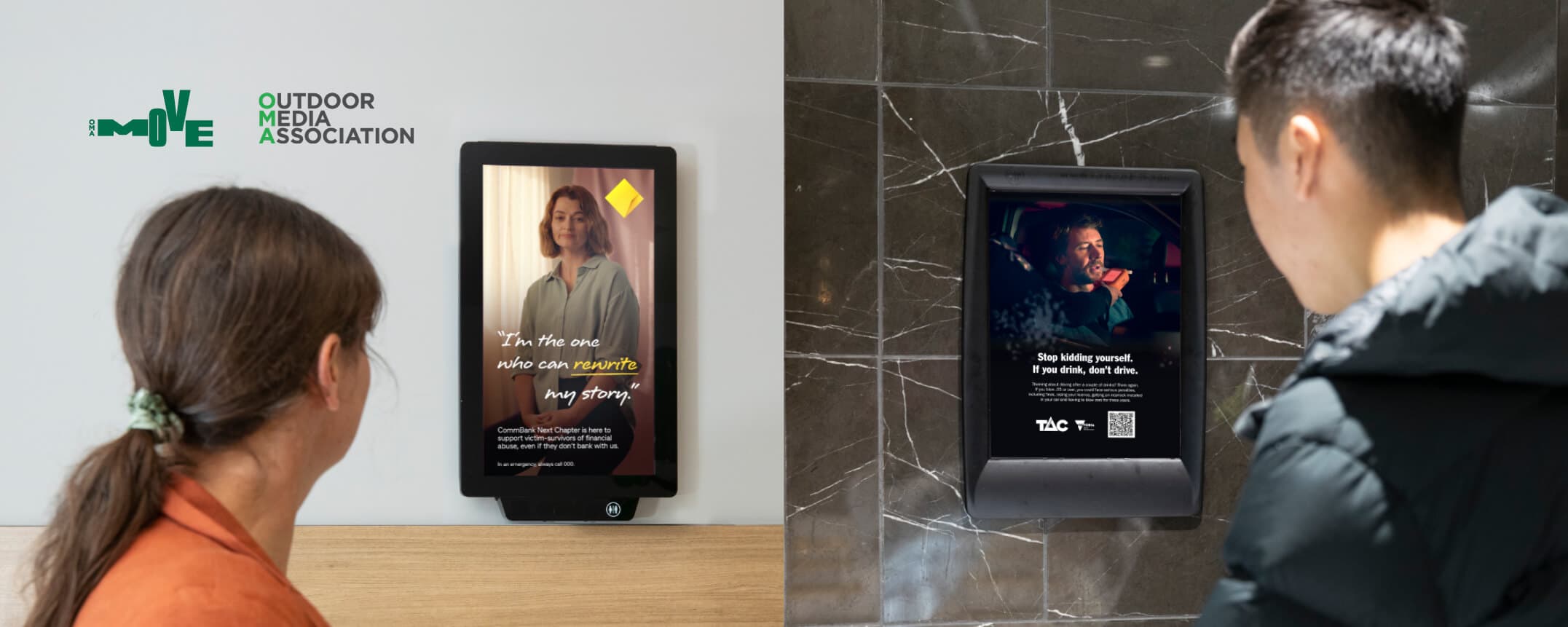
Within this context, discreet, gender-specific environments such as bathrooms within high-footfall public venues offer a setting where sensitive health messaging can be encountered privately and with fewer competing distractions. Convenience Advertising’s national network operates across shopping centres, airports and licensed venues, providing short but uninterrupted periods of attention aligned with everyday hygiene routines. These environments combine privacy, contextual relevance and focused dwell time, allowing individuals to engage with bowel cancer awareness and screening information without the social pressures often associated with public messaging.
For campaigns addressing bowel cancer screening where embarrassment and avoidance are recognised barriers, this type of contextual alignment may help support greater consideration of prevention messaging and encourage screening participation
Communication strategies that combine broad reach with environments capable of supporting deeper message engagement may help bridge the gap between awareness and screening participation.
Within this broader ecosystem, high-attention environments in everyday public settings can provide an additional layer of engagement, helping individuals pause, reflect, and consider preventive health actions, such as completing a screening test or consulting a healthcare professional.
Ultimately, effective public health messaging depends not only on being seen but on being considered.